Part 4 of 4. Growing Crops with Limited Water in 2026 — a Crop Watch series recapping the Yonts Water Conference, April 8, 2026.
With limited canal delivery expected in 2026, pre-plant planning and in-season irrigation management matter more than in a typical year. This article — Part four of a four-part Crop Watch series recapping the April 8, 2026 Yonts Water Conference — translates the weather, historical-yield, and crop-response information from Parts 1–3 into specific decisions producers can act on this spring: a pre-canal water-budget worksheet, crop-by-crop agronomic adjustments, irrigation-system adjustments for furrow and center pivot, and UNL Extension tools available for the 2026 season.
Based on historical rainfall and crop responses to irrigation under the best- and worst-case scenarios, the practical question is: how much water does the crop need before the canal water is delivered? Since the final water delivery date isn't set until May, the following analysis uses June 25 as the delivery date, assuming water won’t be available to producers until then. For canal-water-only producers, this means the period from planting through late June is supported entirely by stored soil moisture plus any in-season rainfall.
Table 1 lays out scenarios for corn, dry beans, and sugar beets using typical planting dates of May 15, June 1, and May 1, respectively, and calculates the water budget. Rainfall from planting to June 25 can vary widely depending on whether it is a wet or dry year. Using sugar beet as an example, in 2002, rainfall in Scottsbluff from May 1 to June 25 was only 1.1 inches, whereas in 2009, rainfall was 6.5 inches. Table 1 uses 2 inches as stored soil moisture and 1 inch as worst-scenario rainfall before June 25. The water budget results differ substantially by crop. For corn planted May 15, crop ET through June 25 is estimated at 3.4, 5.3, and 5.6 inches in a wet (2009), similar (2002), and dry (2012) year, respectively — translating to a deficit of 0.4 to 2.6 inches depending on weather. For dry beans planted on June 1, the shorter pre-canal water delivery window (only 24 days) keeps crop ET at 1.9 to 3.4 inches, leaving at most a small 0.4-inch deficit even in the driest scenario. Sugar beets are by far the most exposed: with a May 1 planting and 55 days before canal delivery, crop ET ranges from 5.7 inches (2009) to 8.8 inches (2012), creating a deficit of 2.7 to 5.8 inches before any canal water arrives. As presented in Part 2 of this series, sugar beets suffered the largest yield loss in 2002 not because they are less drought-tolerant, but because their long pre-canal window coincides with the period when water delivery is most constrained.
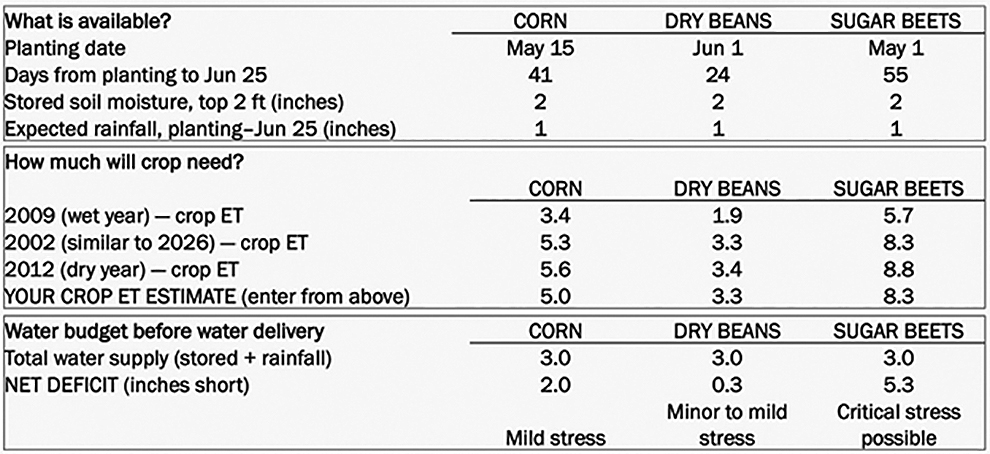
Early-season water balance worksheet: stored soil moisture + rainfall versus crop ET for corn, dry beans, and sugar beets from planting to before canal water delivery (June 25)
Crop Management Recommendations
The sections below translate the research findings from Part three of this Crop Watch series into specific agronomic decisions for the 2026 season.
Corn
- Reduce plant population by 15 to 20 percent. Research shows that at low irrigation levels, lower population corn produces similar yield to high population corn. For example, dropping from 32,000 to 26,000 plants per acre leaves more water per plant (Hergert, 2012).
- Lower your yield goal and cut nitrogen accordingly. Fertilizing for a 220 bu/ac yield goal on a field that will realistically produce 140 bu/ac is wasted money and wasted N. Adjust N rate downward in proportion to the reduced yield goal.
- Consider delaying planting. Most rainfall in the Panhandle occurs in late April to May. Delayed planting might allow producers to capture precipitation that will be critical for emergence. Late planting might also align with water availability better.
Dry Beans
- A 25% deficit (75% of full water) is tolerable. Research shows that keeping beans at 75% of full water needs does not significantly reduce yield (Gradiz et al., 2025).
- Avoid severe stress at any stage. Unlike corn, where one stage (VT–R1) dominates, dry beans are roughly equally sensitive at several stages.
- Consider drought-tolerant varieties. UNL Dry Bean Breeding Program (Dr. Carlos Urrea) has identified several commercially available drought-tolerant varieties:
- Great Northern: SanCarBer (NE1-17-36), Matterhorn
- Pinto: USDA-Rattler, Charro, Stampede
Sugar Beets
- Do NOT reduce plant population. Reducing plant population for sugar beets doesn’t generate the same benefits as for corn. Due to the thinned population, sugar beet can develop a large root system, leading to greater yield loss at harvest.
- Sample soil nitrogen to 4 feet, not 2 feet. Under water stress, sugar beet develops a deeper root system and extracts nitrogen from lower in the profile. If you credit only the top 2 feet for available N, you will over-apply. Unused N left in the lower profile can also reduce sucrose content and increase impurities later in the season.
- Reduce nitrogen rate per ton of expected yield. Use 6.5 pounds of N per ton of expected sugar beet yield instead of the traditional 8 pounds per ton (Ghimire and Maharjan, 2024). Combined with a lower yield goal, this can reduce fertilizer investment.
- Delay planting if conditions are extremely dry. As early water stress is most critical to sugar beet, consider delaying planting to capture precipitation.
Irrigation System Recommendations
The research data above show how crops perform under different total amounts of irrigation. Equally important is how that water is delivered. The two major irrigation systems in the Panhandle — furrow and center pivot — require different adjustments under a short water supply.
Furrow (Gravity) Systems
- Consider conventional or minimum tillage. Heavy residue can slow water advance down the row, increasing deep percolation at the upper end and starving the lower end. Conventional or minimum tillage can make the water "run" more uniformly (Yonts et al., 1991).
- Irrigate every other row. Skipping alternate rows typically reduces the amount of water applied by 30 to 50 percent per set while still wetting each plant’s root zone from one side. The trade-off is some reduction in peak water availability per plant, but it dramatically stretches a limited supply.
- Pack the rows. Firming the furrow bottom reduces intake and allows faster, more uniform advancing of water (Yonts and Eisenhauer, 2007).
- Control the cutoff ratio. The cutoff ratio (the ratio of advance time to set time) is one of the most cost-effective adjustments you can make. See the CropWatch article "Using Cutoff Ratio to Fine-Tune Furrow Irrigations" for field-level guidance and adjust the cutoff ratio accordingly. Yonts (2008) showed that applying the recommended cutoff ratio reduced water applied by an average of 1.4 acre-inches per irrigation (range 0.1 to 3.2 ac-in).
- Use surge valves if available. Surge flow improves water advance uniformity in most soil types and is particularly valuable on longer runs.
Center Pivot Systems
- Increase application depth per pass. Instead of running the pivot fast at 0.75 to 0.80 inches per pass, slow it down to deliver 1.25 inches or more per pass. Larger applications:
- Infiltrate deeper and store water farther down in the profile
- Reduce the wetted surface area as a fraction of total applied depth
- Cut evaporation losses from the wet canopy and soil surface between passes
- Fewer, heavier passes beat many light passes. Under hot, windy conditions, fewer heavier passes generally deliver more water to the root zone per inch applied than many light passes.
Tools and Resources Available from UNL Extension
Several tools and services are available to help you manage irrigation under a limited water supply in 2026:
- ACREE Irrigation Scheduling App. A mobile app (iOS and Android) developed at UNL that supports field-specific water budgeting, leveraging the Nebraska Mesonet weather station network.
- Weekly Crop Water Use Reports. UNL Extension publishes weekly ET and crop water use data during the growing season.
- Capacitance Soil Moisture Probe Network. Fifteen telemetry-enabled capacitance soil moisture probe stations will be available in the Panhandle this season. Contact Dr. Xin Qiao at xin.qiao@unl.edu or 308-632-1241.
Summary
The PREEC Irrigation team will continue to monitor conditions through the 2026 season and share updated information via UNL CropWatch, phrec-irrigation.com, and the ACREE app.
Acknowledgments: Many of the data sets presented in this series come from long-term research programs led by Dr. Gary Hergert, Dean Yonts, and other UNL and regional researchers. Their work provides a solid foundation for the irrigation-management recommendations available to Panhandle producers today.
Authors - Xin Qiao, Nebraska Extension Water Irrigation Specialist; Gary Stone, Nebraska Extension Water and Crops Educator; Saleh Taghvaeian, Jessica Groskopf, Nebraska Extension Agricultural Economics Cropping Systems Educator; Shuhua Xie, Post-Doctoral Research Associate; Joseph Oboamah, Graduate Research Assistant; Carlos Urrea, Nebraska Extension Dry Bean Breeder; Derek Heeren, Professor and Irrigation Engineer; Wei-zhen Liang, Research Assistant Professor; Abia Katimbo, Assistant Professor and Irrigation Engineer