Reducing nitrogen rates in sugar beet production may be possible without sacrificing yield, and early results from on-farm trials in Nebraska and Colorado suggest growers could cut inputs while maintaining profitability.
Background
Nitrogen (N) plays a complex role in sugar beet production, as insufficient rates can limit root yield, while excessive rates reduce sugar concentration and extraction efficiency, ultimately lowering recoverable sugar yield. This tradeoff makes N management challenging for growers, directly affecting profitability, processing quality and environmental outcomes. Improving N management, therefore, represents a key opportunity to enhance both economic returns and conservation outcomes in sugar beet production.
To address this challenge, the University of Nebraska-Lincoln (UNL), in collaboration with Western Sugar Cooperative (WSC), has initiated a USDA Natural Resources Conservation Service (NRCS) – funded project focused on optimizing N management for sugar beet growers. This five-year effort (2025-29) aims to promote the adoption of Conservation Practice Standard 590 (Nutrient Management) for sugar beet by validating reduced N fertilizer strategies that improve sugar yield and quality while reducing environmental losses.
On-Farm Research Approach
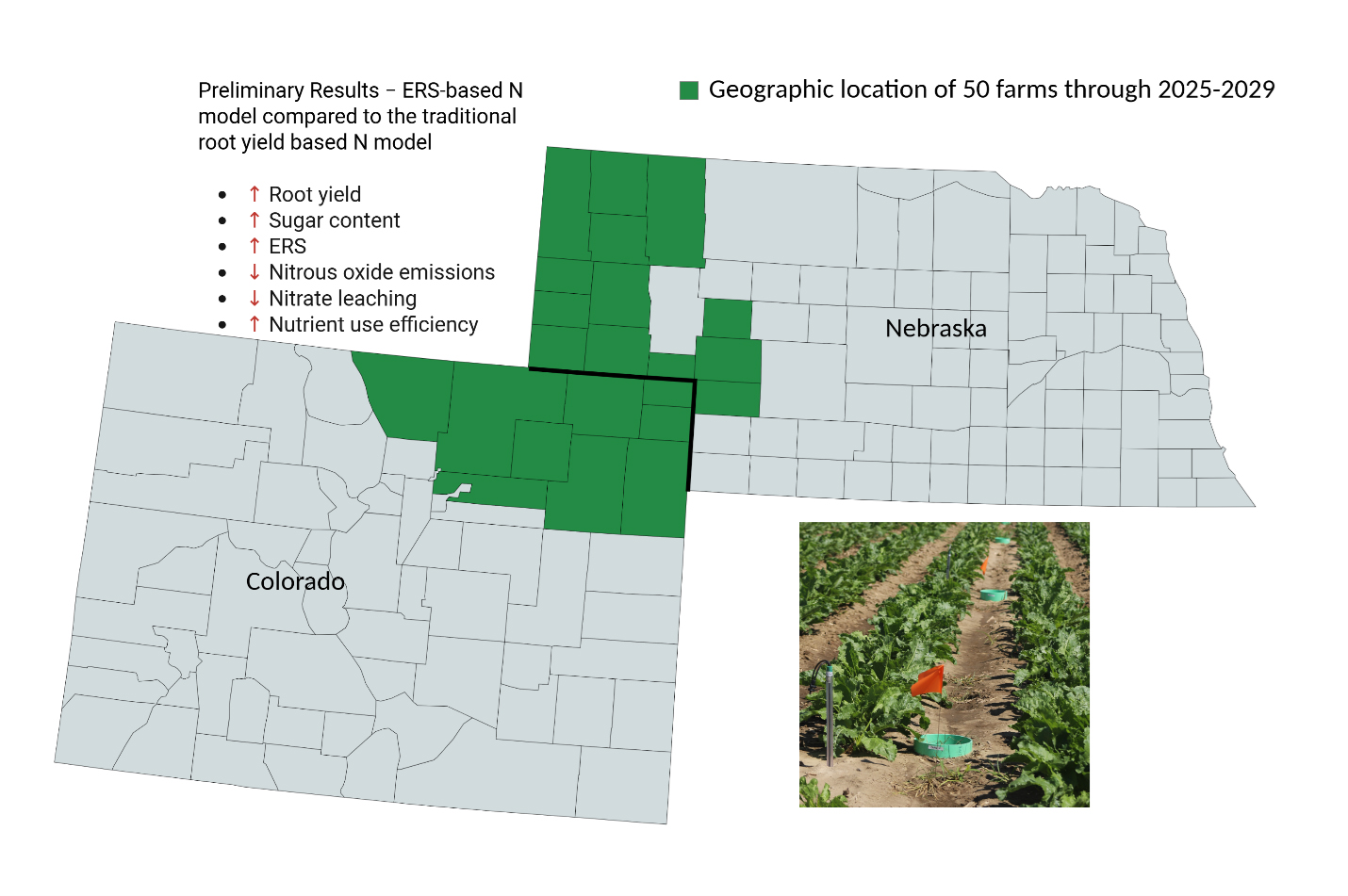
Over the course of four years, the project will engage 50 sugar beet growers across Nebraska and Colorado (Figure 1) through on-farm, split-pivot side-by-side comparisons of traditional N fertilizer recommendations based on root yield and a new model based on the estimated recoverable sugar (ERS).
Our small-plot research experiments suggested that beet growers can reduce N input without a yield penalty when they use the ERS-based N recommendation. The traditional root yield model estimates that 8 lb of N is needed to produce 1 ton of sugar beet. In contrast, the ERS model estimates a lower requirement – about 6.5 lb of N per ton of beet produced.
Thus, the ERS model reduces N fertilizer application by 45 lb/acre for an average beet yield of 30 tons/acre.
This on-farm research aims to test the ERS-based N model on the farm scale and includes economic and environmental analyses to support the model. Nebraska and Colorado were selected to ensure consistency in soil and N management and irrigation systems, thereby enabling a thorough regional evaluation of the new model’s effects.
The effectiveness of the ERS-based N model will be assessed by measuring environmental impacts and agronomic performance over the four years of the study:
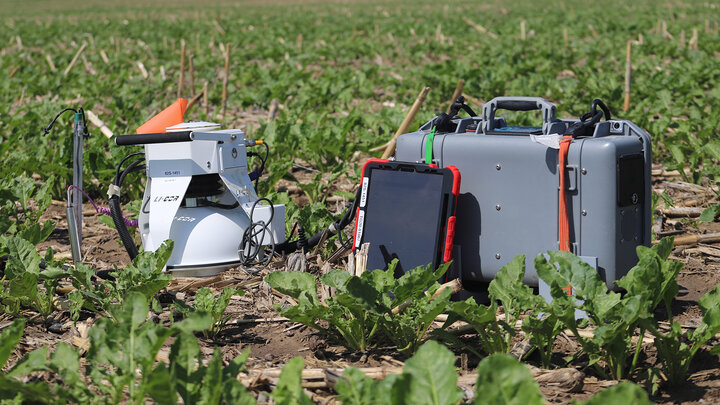
- Soil, water, and plant tissue sampling and analysis (20 selected sites)
- Measurement of environmental N loss via leaching and emissions (20 selected sites)
- Evaluation of root yield, sugar concentration, estimated recoverable sugar (ERS), and sugar loss to molasses (SLM) (50 selected sites)
- Nitrogen use efficiency (NUE) (50 selected sites)
- Economic analysis in the final year (50 selected sites)
- Life cycle assessment to quantify broader environmental impacts
Preliminary Results
Results from the project’s first year, averaged across all locations, demonstrated that reduced N inputs under the ERS model could maintain or slightly improve productivity while substantially minimizing environmental impact. The N concentration in sugar beet leaf, NDVI, and NUE indicated that the ERS N model did not limit sugar beet N utilization.
Overall, compared with the traditional N treatment, the ERS N model resulted in:
- Slight increase in root yield (1.4%), sugar concentration (0.6%), and ERS (2%) (average of 12 locations).
- 18% less nitrous oxide emissions and >80% less nitrate concentration in leachate water samples collected at 4-foot depth (average of 3 locations).
- 23% and 25% increase in NUE based on the root yield and ERS, respectively (average of 9 locations).
Project Progression
The primary objective of this USDA NRCS– funded project is to generate reliable, regionally relevant data associated with reduced N inputs. Data collected from 50 farms will provide the foundation for future conservation incentive programs and confidence in nutrient management recommendations.
As a wholly grower-owned cooperative, WSC provides a trusted and direct pathway for sharing research results with producers. Grower fact sheets, field updates and educational materials will be distributed throughout the cooperative to promote confidence in the ERS N model and to encourage adoption of improved stewardship practices. Surveys conducted among growers before and after the study, in collaboration with the UNL Bureau of Sociological Research, will help identify barriers and opportunities for broader implementation.
For additional information and on-farm trial enrollment for the 2026 season, contact bmaharjan@unl.edu or nheldt@unl.edu. Farmers enrolled in this project save on N inputs based on the ERS model and also receive $118.80 per acre for each acre on which N input is reduced as per the ERS model. Incentives are meant to compensate for any foregone income due to potential yield loss but are paid regardless of yield outcome.
Through collaboration with WSC leadership and technical staff, UNL aims to support profitable sugar beet production while advancing conservation stewardship across the northern sugar beet-producing region.