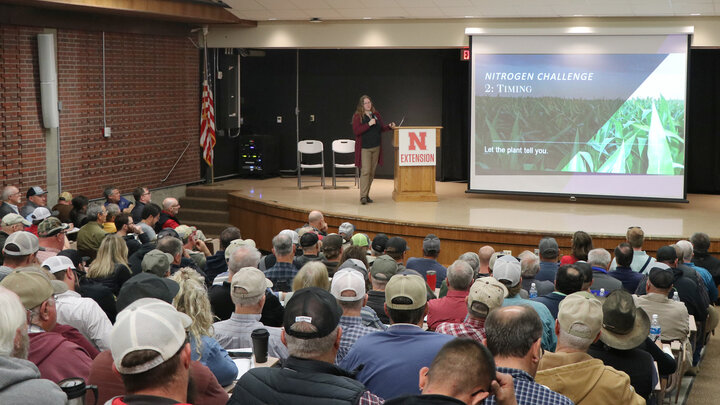
The Annual On-Farm Research Results Meeting was held on Thursday, February 26, at the Knight Museum in Alliance. Growers from the Panhandle were in attendance to learn about locally conducted research and more than 100 On-Farm research projects across Nebraska.
“The data is analyzed, and we create an ‘On-Farm Research Results’ publication every year. We can't go over every report in the whole book, but we do talk about the research that's pertinent to our part of the state,” said John Thomas, Nebraska Extension Educator in Box Butte County.
In the Panhandle, Nebraska Extension Educators Thomas, Gary Stone, and Samantha Daniel conducted seven On-Farm research studies, including winter wheat and black-eyed peas.
“For a third year, we did a Pod Ceal study on dry edible beans, which is a harvest aid product,” Thomas said. The Pod Ceal product is sprayed on beans late in the season with the desiccant. The grower and Thomas were hoping the product might reduce harvest loss with direct harvest of dry edible beans. “What we found didn't really reduce harvest loss or increase our yields with the dry bean harvest. It is of some value in protecting seed color if they're out in the field for extended periods.” They also found that with light hail, shelling was reduced slightly. At about .6 bushels, so not a great product if the grower wants to reduce harvest loss and increase yields
The researchers also studied an inoculant that not many people use in western Nebraska, where beans are grown. There's usually enough natural inoculant in the soil to work with the beans. The team found, after three years of study, that in soil nitrogen-deficient conditions, the dry bean crop can benefit from an inoculant and experience a significant increase in harvest yield. The inoculant is applied to the seed at planting time. It's an inexpensive addition to boost yield.
Great Northern dry bean varieties were the subject of a study with Kelley Bean. The company supplied the beans, and the research team collaborated with growers to look at four different varieties.
“This year, we had some hail damage and some disease pressure, and so we got to see how four different varieties performed under those conditions. Based on that Great Northern variety study, we learned that the Virgo variety came through really strong in comparison to some of the other varieties that we had looked at,” Thomas said. A review of previous years found Virgo to be a good, upright Great Northern variety for direct harvest.
In addition to crop studies, Adam Leise, Nebraska Extension Educator, shared results from studies across the state that had some applications to western Nebraska. There was a talk on crop insurance, cost of production, and economic information for growers. Nevin Lawrence, Nebraska Extension Weed Management Specialist, also discussed Palmer amaranth management.