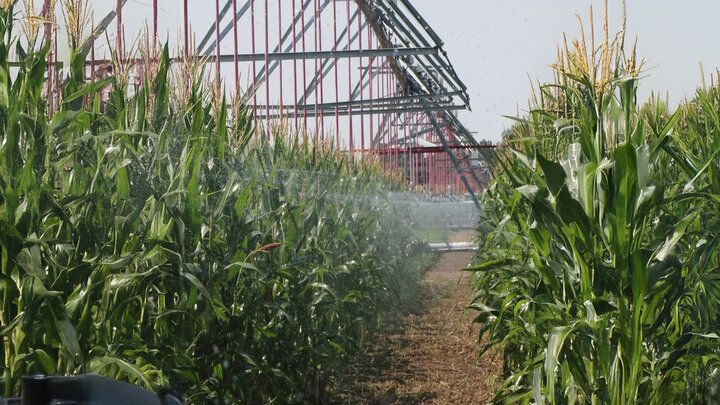
Producers in the western Nebraska Panhandle are entering the 2026 season with a severely constrained surface-water supply and dry soil conditions. This is not the first-time growers in the region have faced these conditions, but not all drought years are alike. Looking back at the two most commonly cited drought years in recent memory, 2002 was the closest analog to what we are facing in 2026, with both dry weather and shortage of surface water supply; 2012 was a very dry weather year, but surface water delivery on the North Platte system was close to normal.
This article is part one of a four-part Crop Watch series that recaps the April 8, 2026, Yonts Water Conference and lays out where 2026 actually stands. It summarizes annual precipitation, cumulative precipitation, and reference evapotranspiration (ET) going into the season, and current soil-moisture status at the PREEC research plots, so producers can size up their starting conditions before locking in planting decisions.
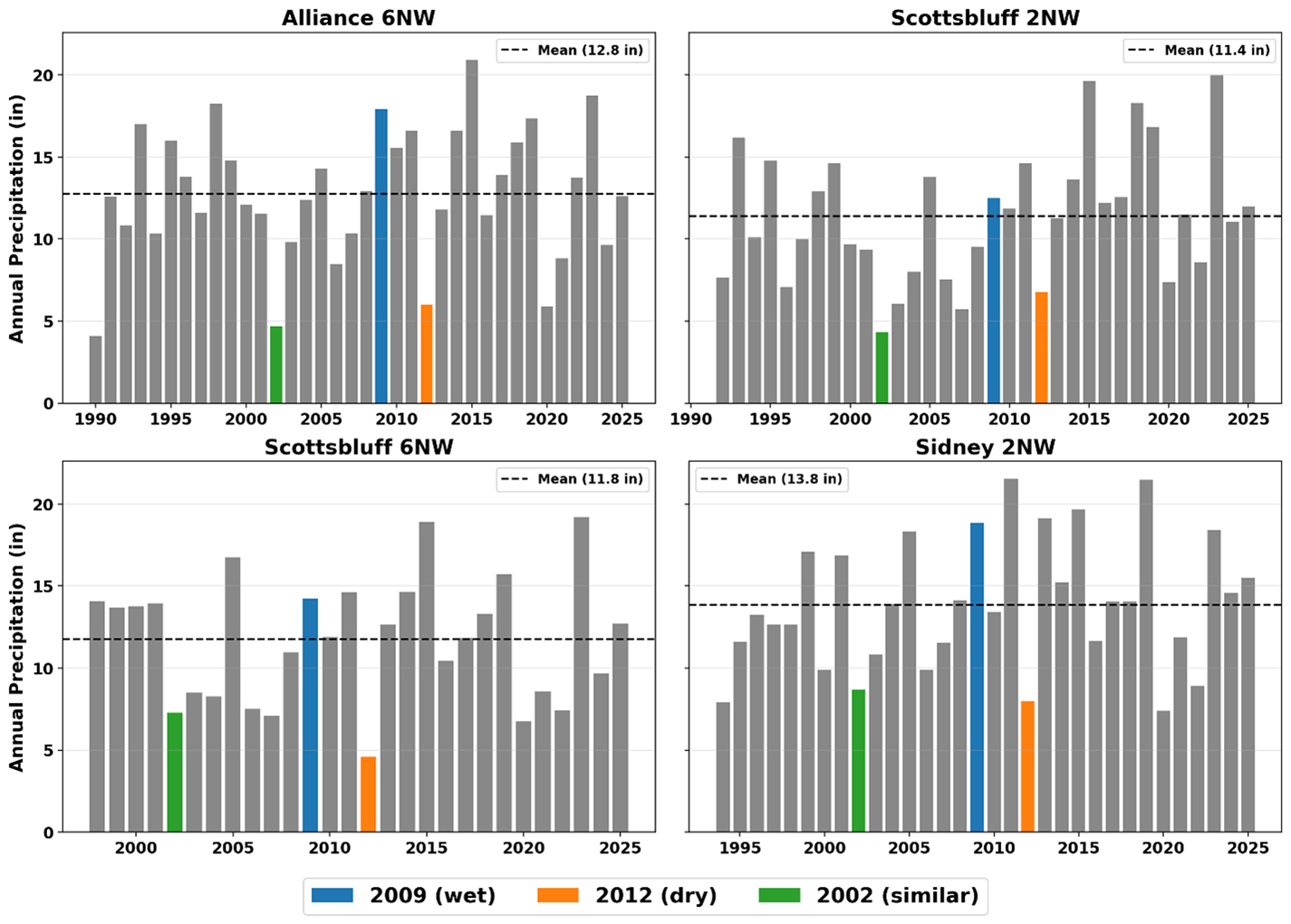
Long-term annual rainfall according to four Nebraska Mesonet stations at Alliance (6NW), Scottsbluff (2NW and 6NW), and Sidney.
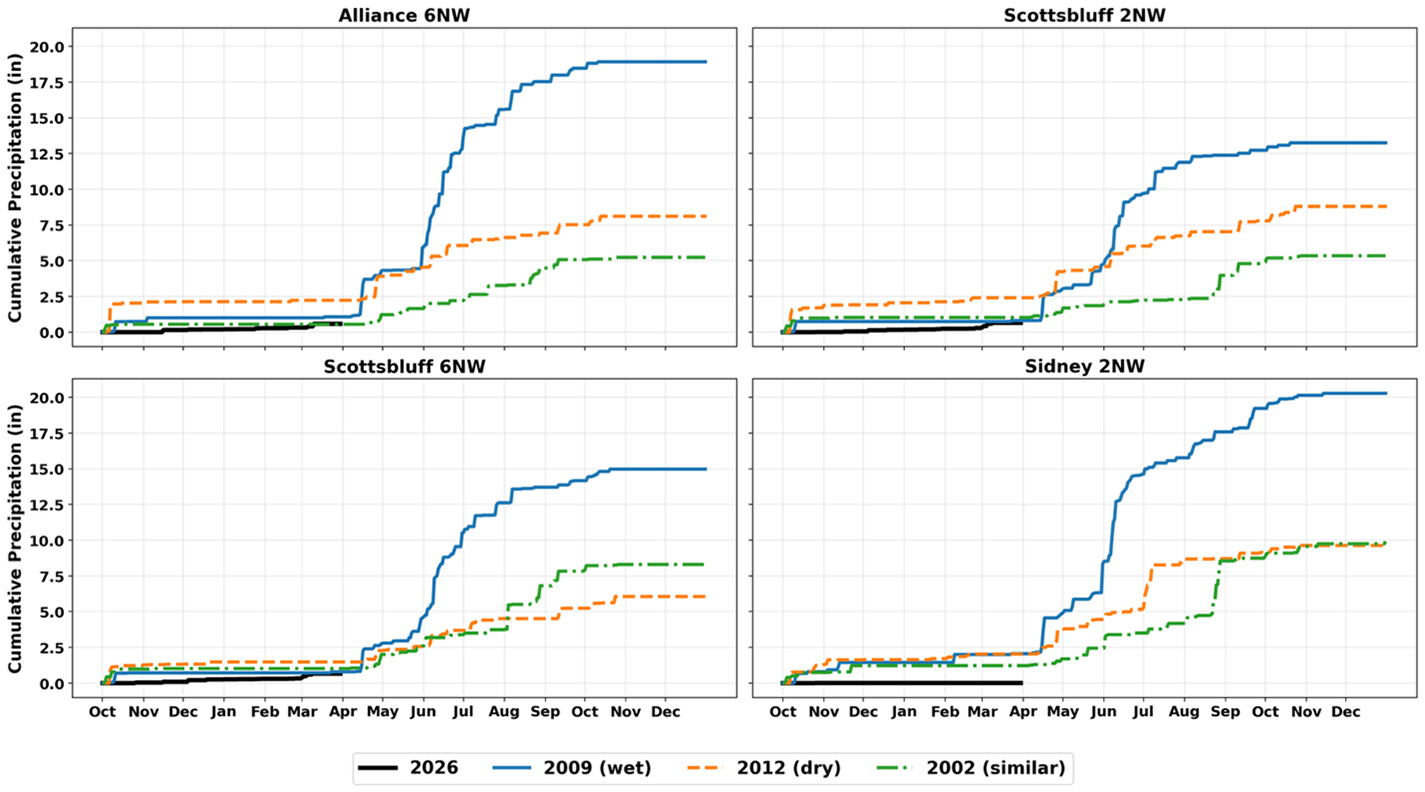
Shows cumulative rainfall from last October into current year for 2002, 2009, 2012, and 2026. This accounts for potential snowfall in winter/springtime and gives a producer a better idea of where we are at in 2026. As shown in the figure, 2026 precipitation from the four weather stations is lower than any of the previous three years.
Annual rainfall and reference ET in key years
Figure 1 shows 25+ years of precipitation data from four Nebraska Mesonet/AWDN stations at the Panhandle area. Long-term average annual rainfall was 12.8, 11.4, 11.8, and 13.8 inches, respectively. In 2002, annual precipitation was 36%, 38%, 63% of long-term average at Alliance, Scottsbluff, and Sidney locations, respectively.
Reference evapotranspiration (ET) is an integrated parameter that accounts for air temperature, humidity, wind, solar radiation, etc., in determining evaporative demand. Depending on the crop growth stage, crop water use (ET) is usually a fraction of the reference ET. Higher reference ET typically indicates warmer temperatures, windy conditions, high solar radiation, and, as a result, higher water demand. Figure 3 shows cumulative reference ET from the previous October into the current year. Again, the cumulative reference ET in 2026 has been higher at all four weather stations than at the same time in previous years, indicating this year is drier than any of the previous years. Note that reference ET assumes ET from a healthy, well-watered surface area (alfalfa in this case), which doesn’t mean the actual crop ET.
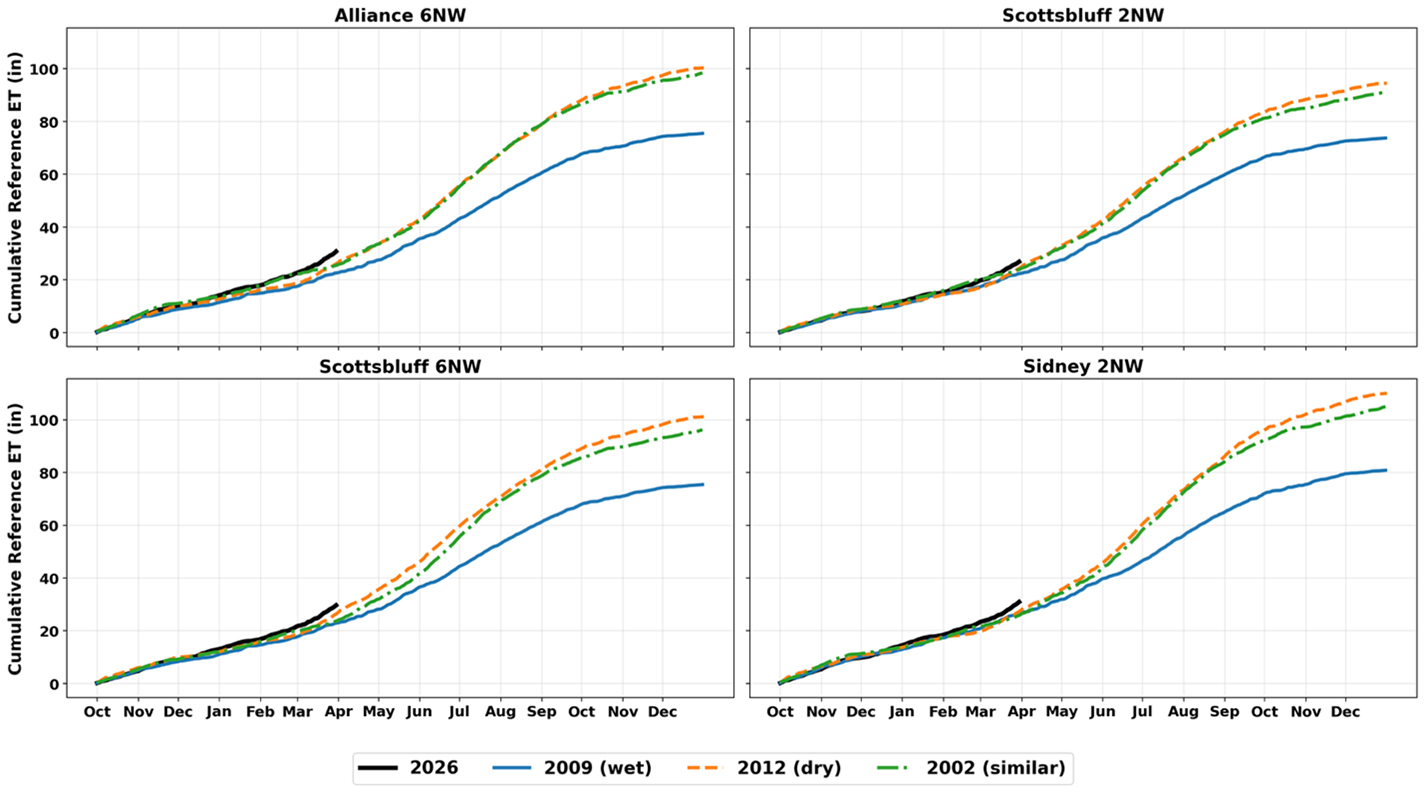
Cumulative alfalfa-based reference evapotranspiration from previous October into current year in 2002, 2009, 2012, and 2026 (as of 3/30/2026) at Alliance (6NW), Scottsbluff (2NW and 6NW), and Sidney.
Current soil moisture at PREEC research plots
The soil in western Nebraska is mostly Tripp Fine Sandy Loam, with a water-holding capacity of 1.8–2 in/ft of soil. Most of the time, due to irrigation, winter snowfall, and spring rainfall, producers start the season with a full soil water profile. This is probably not the case in 2026. The PREEC Irrigation and Digital Ag team conducted soil core sampling on 4/6/2026 at 1 ft intervals down to 4 ft depth and calculated volumetric soil water content (VWC) at the corresponding depths. The results confirmed that, as of April 6, 2026, growers should not count on a full profile going into planting. Full water holding capacity (top 2 feet) at PREEC is approximately 3.6 to 4.0 inches. Fields that grew sugar beets in 2025 are carrying roughly 1.0 inch of plant-available water in the top 2 feet — a substantial deficit. Fields with no crop in 2025 (fallowed due to hailstorm) have about 0.9 to 2.9 inches in the top 2 feet, depending on residue cover.
In practical terms, most fields are beginning the 2026 season with 50 percent or less of full profile moisture in the top 2 feet. When canal supply is limited, pre-season soil moisture becomes the single most important "reservoir" on the farm, and every inch missing from the profile must be made up by in-season irrigation or rainfall.
What this means for 2026
The conditions heading into 2026 are closer to those in 2002 than in 2012. In 2002, both canal water delivery and weather failed at the same time; in 2012, the weather was dry, but canal delivery was close to normal. The yield consequences of those two years were very different — a topic covered in Part 2 of this series, which compares 2002, 2009, and 2012 yields for corn, dry beans, and sugar beets across four Panhandle counties.
Authors - Xin Qiao, Nebraska Extension Water Irrigation Specialist; Gary Stone, Nebraska Extension Water and Crops Educator; Saleh Taghvaeian, Jessica Groskopf, Nebraska Extension Agricultural Economics Cropping Systems Educator; Shuhua Xie, Post-Doctoral Research Associate; Joseph Oboamah, Graduate Research Assistant; Carlos Urrea, Nebraska Extension Dry Bean Breeder; Derek Heeren, Professor and Irrigation Engineer; Wei-zhen Liang, Research Assistant Professor; Abia Katimbo, Assistant Professor and Irrigation Engineer


