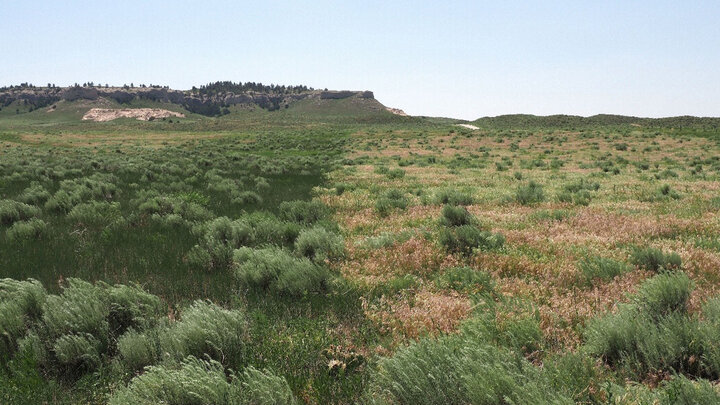
Western Nebraska ranchers and land managers face major challenges with invasive grasses invading the rangeland and Pine Ridge. Estimates of over 20 percent, or approximately 2.3 million acres, of the Nebraska Panhandle alone are infested with invasive grasses, predominantly cheatgrass. In addition to impacting the environment and native forb and grass forage production for livestock, cheatgrass poses an extreme fire hazard when mature.
Nebraska Extension Educators and specialists, in cooperation with industry, provide the training and education to keep our ranchers and land managers apprised of the latest technology available to help manage cheatgrass. Utilizing information from workshops, test plot strips, and plot tours, ranchers can make sound economic decisions regarding their livestock production operations, and land managers make environmentally sound recommendations in fire-prone areas.
For over four years, Nebraska Extension helped establish numerous test plot strips with the herbicide combination of Indaziflam (Rejuvra®) and Imazapic (Plateau®) across the Nebraska Panhandle. Industry-provided data illustrated the economic benefit to ranchers from this herbicide application.
These test plot strips provided graphic results, both short- and long-term, of the effectiveness of the herbicide application. These test plot strips also provided Nebraska Extension specialists with a basis for research programs to determine the benefits of increased native grass production, soil health, and overall long-term environmental benefits.
The herbicide combination treatment is costly, but it is one of the most effective tools to manage cheatgrass. The treatment provides multiple years of cheatgrass control. Nebraska Extension research showed that native perennial grass biomass production was 2.5 times greater than in untreated areas. Ranchers and land managers treated small areas on their own to determine if the economic and environmental benefits were valid. In the following years, the same individuals increased the number of treated acres as they found that the herbicide treatment increased native forage production and quality, resulting in higher weaning weights and better cattle conditioning. Land managers were able to obtain grants to help offset the cost of the herbicide treatment and to apply it to fire-prone areas and areas affected by fire to prevent reinfestation by cheatgrass.
Ranchers and landowners should contact their local Natural Resources Conservation Service (NRCS) office for available programs to mitigate invasive grasses.