Almost too small to see with the naked eye, thrips can be in your dry beans, and you’ll never know until you see cupping on leaves. Dry bean growers, especially in southwestern Nebraska, often apply insecticides for thrips, although little is known about the impact of thrips on production.
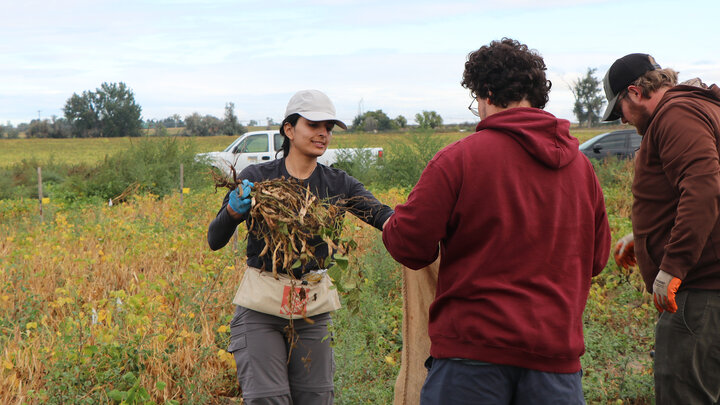
University of Nebraska-Lincoln (UNL) Master’s Student Aarju Aryal has been conducting research on slender insects with fringed wings, only a few millimeters long, at the Crop IPM Entomology Lab at the UNL Panhandle Research, Extension and Education Center (PREEC) in Scottsbluff.
“They injure bean plants by feeding on and laying eggs in plant tissues, including leaves, flowers, and pods. In addition, thrips can transmit plant viruses, causing diseases in dry beans,” Aryal said. “Warm, dry springs accelerate thrips population growth, leading to higher infestations.”
Aryal has been identifying thrips species in dry beans, comparing classes and varieties to determine which are good hosts for thrips and which tend to support higher or lower populations. She is also testing the commonly used neonicotinoid seed treatment and foliar insecticide to evaluate how well the insecticides reduce thrips abundance and damage.
“We are looking beyond the crop itself, at the common weed species growing in and around bean fields, to identify which of them serve as alternative hosts where thrips populations can build up before moving into the dry beans,” she said.
Many growers plant seed treated with a neonicotinoid insecticide as a precaution against them. Later in the season, when leaf cupping caused by thrips feeding shows up in the field, a foliar spray of acephate often follows. Both of those management actions are made without knowing whether the treatment reduces thrips numbers or damage, and without knowing how much yield loss, if any, thrips would have caused had nothing been applied. Very little information exists on which thrips species feed on dry beans in the western and southwestern region of Nebraska, or on how their feeding affects plant growth and yield. Those knowledge gaps leave growers investing in treatments with unknown returns.
Future studies will develop economic thresholds linking thrips abundance and crop injury to yield loss, helping growers determine when treatment is justified. Refining scouting methods and identifying vulnerable growth stages will support more timely, targeted, and cost-effective management decisions.
The Crop IPM Entomology lab at PREEC continues to conduct research to address critical knowledge gaps through a combination of field trials at the research station and laboratory studies since 2024. Through field sampling in 2024 and 2025, two thrips species were identified commonly feeding on dry beans across the Nebraska Panhandle: western flower thrips (Frankliniella occidentalis) and onion thrips (Thrips tabaci). The western flower thrips is the predominant species, present in dry bean fields throughout the growing season.