2026 has overall been a high moth population year. The moth flights are approaching the end.
Still for dry beans: scout now across Western Nebraska; consider treatment if pod feeding exceeds 0.5-1%; the ideal treatment window is 10-21 days after flight peak. Again, for corn, if larvae have moved down the silk in ears, contact insecticides will not be effective.
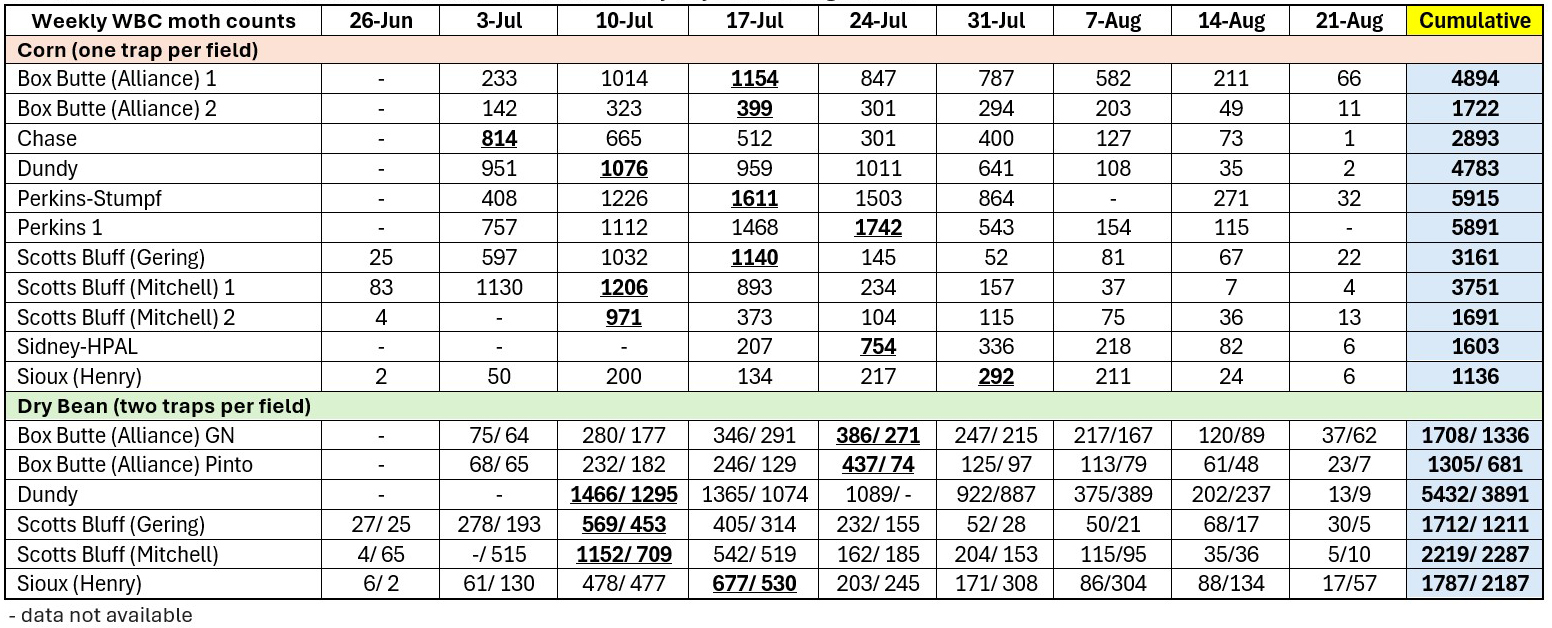
For corn, a match between moth flight and the late whorl-to-early tassel stage can result in high levels of infestation. For beans, if the cumulative moth catch at peak moth flight (50 percent emergence) per green bucket trap is < 1200, between 1200 and 1700, or> 1700, the risk of significant damage is low, moderate, or high, respectively. Note that it is a risk assessment; actual bean damage and economic risk from larval feeding require scouting.
Cumulative moth catch numbers will be updated weekly. Green bucket traps are monitored by UNL PREEC Entomology Lab (Scotts Bluff and Sioux Counties), John Thomas (Nebraska Extension Educator; Box Butte County), Samantha Daniel (Nebraska Extension Educator; Chase, Dundy, Perkins Counties), and Dr. Vinicius Zuppa (Nebraska Extension Educator; Cheyenne County). Weekly trap data are compiled by UNL PREEC Entomology Lab.